Showing posts with label musique. Show all posts

19.3.10

"A lot of people say that it's a family thing..." - Busy P

EMI's recent troubles clearly demonstrate that the music recording industry is not about to recover from the digital revolution caused by Napster. Of course, the recent economic crisis hasn't helped but the four major labels can only blame themselves for the current turmoil in the recording industry. They failed to notice the business opportunity available online. They got lazy and stopped innovating. Sony-BMG, Warner, Universal and EMI thought that they had it all figured out so they just sat back and waited for the money to come in. Unfortunately for them, recorded music sales continue to drop significantly which isn't good since 70% of their revenue depends on these sales (City A.M.). However, this doesn't mean that the recording industry is dead. People still and always will consume music. They are just consuming it in a different way. No one has found the perfect new business model but certain music entrepreneurs have discovered alternative ways to sustainably run record labels. One interesting case is Ed Banger Records, a successful boutique record label.

Pedro Winter (better known as Busy P) started Ed Banger Records in 2002. He used to manage Daft Punk and decided to reinvest the money he made from that career into a new venture. He leveraged the connections and insight he gained during his time with Daft Punk to create a new kind of record label. His first signing was Mr. Flash but Ed Banger Records now represents fourteen different acts. Although all of the artists on its roster are unique they can almost all be categorized under the electronica music genre. Indeed, Ed Banger Records played an important part in reviving the French electronic music scene with bands such as Justice reaching international stardom. However, Ed Banger only became an "it" label in 2006/2007. It took this boutique label a good 4 years to obtain the recognition that it deserved. Pedro Winter accomplished this by focusing on two key factors.

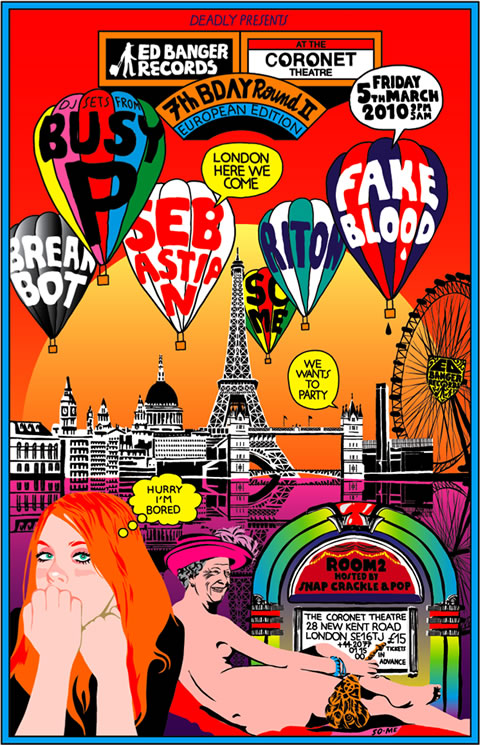
Unity: The Ed Banger family is known as the Ed Banger Crew. Busy P's the father figure and all of the artists on his record label are his kids. There's a feeling of belonging and camaraderie that you won't find at any major label and even at a lot of independent labels. By running the record label in a communal manner, Pedro Winter has created a tight-knit group of artists. An indestructible unit. During its beginnings, music fans often discovered the label before they discovered its roster. He's accomplished this by promoting the record label itself, rather than the individual artists on the record label. He launched the Ed Banger tours where the label's artists dj all together. Every act is on stage at the same time. Xavier from Justice will play a few tracks, then DJ Mehdi will take a turn, followed by Busy P. Unlike your typical dj party, they don't stick to specific fixed time slots for each dj set. If someone can think of a good track to spin next they simply take their turn at the decks. Ed Banger Records recently celebrated its 7th birthday. To mark the occasion they threw two parties, one in New York City and one in London. Justice, Busy P, DJ Mehdi and Breakbot djed in NYC, while Busy P, SebastiAn, So Me and Breakbot took care of the party in London. During these dj sets they'll often play each other's tracks. They are proud of each other's work and will often produce remixes for each other. This mutual respect amongst the artists on the label only increases the sense of unity. Busy P has been releasing Ed Rec compilations to further promote his label's group mentality. There have been three volumes so far. These Ed Rec tours and releases help promote the artists on Ed Banger Records as a whole. No act feels more important than the other. This family feeling has allowed Ed Banger Records' artists as well as its fan base to interact in a unique and special way.

Consistency: One of the big differences between Ed Banger Records and other record labels, is that Ed Banger Records has one artistic director. So Me is in charge of creating all of the label's artwork. He makes the label's record covers, flyers, posters and promotional merchandise. In other words, Ed Banger Records has its own one-man art department. This has allowed the label to create a consistent visual image. Indeed, although So Me makes different artwork for each recording artist on the label, each piece still has that signature So Me aesthetic. His work has a cartoon-y, pop art feel to it that electronic music fans instantly recognize. His artistic talent has transformed the records, along with Ed Banger's other products, into collectibles. You're not just buying music on a CD, you're buying an art piece too that you can display proudly. One just has to look at the Ed Rec discography collage on the label's myspace page to understand what I'm talking about. So Me's artwork for Ed Banger has become so popular that it has also led to some interesting brand extension opportunities for the label. The Ed Banger Crew and a few friends launched the Cool Cats website so that fans could buy any Ed Banger Records merchandise as well as other limited edition products. So Me's t-shirts have been selling extremely well. They are worn proudly by the Ed Rec nation (I can't imagine anyone wearing a Universal Music or Domino Records t-shirt, can you?). The t-shirts made for Justice's D.A.N.C.E video were also up for sale and instantly sold out. These t-shirts are released in limited quantities making them sought after clothing items. In addition, Ed Banger Records has collaborated with WESC to make headphones (or edphones), there is now an Ed Banger vs. Eastpak range of bags, and Justice and So Me made a limited edition Coca-Cola bottle. These business ventures have all helped further promote the Ed Banger brand.

Busy P is the key figure behind Ed Banger Records' success. He is the one who decided to start a record label that would operate differently than the ones in the past. His distinct approach has allowed his record label to differentiate itself from the rest. Even though his label was rapidly becoming popular he expanded in a reserved manner. By 2006, Ed Banger Records was the label of the moment. However, he didn't start signing any artist he could. He wanted to keep the "family" quite small and decided to grow at a slower pace so that he could continue managing the label properly. Just like in any business, growth is important but you want to grow in a sustainable manner. As Pedro Winter explained to Scion Radio: "...at Ed Banger the idea is to keep the family quite small because, you know, we are still a small team and I don't want to be crazy, because everybody is looking at us and because we are the label of the moment I don't want to become crazy and sign everything and everybody." It's by adopting this attitude that Ed Banger Records is still around today.

Of course, Ed Banger Records has made mistakes. At times, Busy P's label wasn't releasing new material fast enough to sustain its rapid ascension. Today's music consumers have short attention spans. In order to keep their attention, record labels must strategically and consistently release new music. Uffie's Pop the Glock was a huge hit in 2006 but the video was not released until 2009 and she has yet to release her debut album. She is no longer relevant, therefore her CD will most likely sell poorly. After the release of Justice's Cross, Ed Banger Records failed to release another album to continue generating hype around the label. And let's not even talk about the signing of DSL. This electro infused rap group just doesn't fit in. However, with the fairly recent signing of Breakbot things seem to be getting back on track. Breakbot released some well received mixes as well as an EP. In addition, a couple of Ed Banger Records' older artists are expected to release new material soon. A few of SebastiAn's new tracks have already found their way online. DJ Mehdi has teamed up with Riton to form Carte Blanche. Justice is also rumoured to be releasing a new album this year. If Busy P plays things right (as he has already done in the past), Ed Banger Records could once again become the label of the moment. Only time will tell.

11.2.10

"When you drape your music in effects, it actually undercuts the music itself." - Bob Lefsetz (RM part 2)

The late 90s and 2000s gave us mainstream acts such as Britney Spears, Blink-182 and 50 cent. Although these acts belong to different musical genres they all reflect the state of the mainstream music industry during the past decade or so. For the past ten years music has been too polished and overproduced making a lot of acts seem repetitive and bland. As a result of this, certain music fans started searching for something else. The musicians they discovered were individuals who created music with very little means. These artists were demonstrating that you didn't need the newest instruments, proper equipment or state of the art recording facilities to make records. Their reason for being was to create records that were different from what was being played in the mainstream and the difference was their lo-fi sound. Lo-fi music has existed for awhile now but this genre is currently experiencing a resurgence. Bands such as Wavves, A Grave With No Name and The Bitters (to name a few) have been getting their first tastes of success. These lo-fi bands are at the forefront of the realness movement in the music industry.

As during most periods, there are a lot of overlapping elements between the fashion (which I mentioned in my previous entry) and music scenes of the late 90s and 2000s. In this case, both of these scenes were overly glamourous and polished. Musically, the pop artists from this era all created music that was layered in unnecessary effects. When it comes to their image, pop acts such as Britney Spears are made up of plastic dolls that do everything they are told, pop punk acts such as Blink-182 are promoting the "punk" way of life while touring in luxury buses and living in mansions and hip pop acts such as 50 cent are trying to play-up the "gangster" (sorry, "gangsta") image while spending too much time smoking weed, insulting rivals in safe interview settings and carrying guns for show. Unfortunately, the mainstream music industry hasn't stopped promoting slightly updated versions of the previously mentioned pop acts but at least this has motivated a new generation of musicians to create more authentic music.

Lo-fi music is defined as "the production or reproduction of audio characterised by an unpolished or rough sound quality." (merriam-webster) Bands searching to create a lo-fi sound pride themselves in making music with very limited tools at their disposal. Wavves started making music in his bedroom using Garageband. The members of A Grave with No Name record in friends' bedrooms if they can't record in theirs. They are making music out of love and are willing to sacrifice a lot to get their music out there. They'll tour endlessly in shitty vans, play in dive bars/clubs and sleep on couches. To a certain extent, it's become cool to do this. As Ben Cook from the Bitters explained to dazeddigital: "I guess even more so now people aren't paying attention to ANYTHING that sounds like it could be played on a radio station. The more shitty and obscure, the more elite and rad you feel, right?" But this doesn't mean that everybody and anybody can produce good lo-fi music. Ben continues by stating that "...the availability of low budget recordings only sets apart the true songwriters from the bored kids with a laptop." You still have to have talent to make lo-fi music.

The lo-fi sound is fuzzy, distorted and rough but underneath it all you will find good melodies and songwriting. That's why it's appealing. It still is good pop music but lo-fi musicians decide to record it in a minimal way. Take Wavves, for instance. So Bored and No Hope Kids are feel good tunes that are extremely catchy. They're simply dirtier and more abrasive pop songs. Lo-fi musicians, like Wavves, are stripping their music down. Keeping it simple. Taking away the extra layers of production. These bands make the best of the few tools they have. In a way, they are showing the world what the music making process used to be like. Lo-fi music is bringing it back to a time when music was raw, natural and organic. A time when the magic happened when you were physically playing your instrument. Not in post-production. In this sense, they are helping make "real" music again. It's for this reason that lo-fi music has reached a popularity level unseen since the days of Sebadoh and Pavement.

The musicians creating lo-fi music today are offering an alternative to young music goers who are fed up with the music promoted by the mainstream media. The fans and bands alike are indirectly rebelling against the mainstream music industry. They want to create and support music that isn't perfect. By stripping down the layers and keeping it raw and simple there's a certain energy to it that you don't often find in mainstream music today. It seems more personal, more honest and more believable. I know that I've used the word "real" a lot and you're probably getting sick of it by now but that's the simple word that fans need to associate with your band in order for you to be successful. And although it's a simple word, it's not a simple concept to grasp. There's no formula for it. It just happens. The best chance you have to be perceived as "real", is to be true to yourself. More specifically, let your music speak for itself because at the end of the day that's all it comes down to.

11.1.10

"Seems like we created a logo" - So-Me

According to the online free dictionary a cross is "An upright post with a transverse piece near the top, on which condemned persons were executed in ancient times." However, it is most often associated with the word "crucifix" which is the "representation of the cross on which Jesus died." The cross has been around for thousands of years and although it's been used for different purposes no one has ever thought of re-appropriating it. It's a sacred and ancient symbol, so who would ever dare to use it as the logo for their band? Well, apparently, two french guys from Paris didn't see any problem with this and they've turned it into one of the most recognizable images in the electronic music scene.

Now, some of you are probably wondering how Justice came up with the idea to adopt such a universal symbol as their band's logo. Gaspard explained to Mojo that: "It came from a very simple idea [they] had when [they] did Waters of Nazareth, which was to compare the energy you can have in a church, the kind of mystical vibe of it, and the energy you can find in a club. Everybody is gathering together and focusing at the same point." Indeed, the concert hall can be seen as the young generation's church. Since the vast majority of teenagers don't believe in God and don't go to church, they found another holy sanctuary in the music venue. Similarly to a church, it's a place where we gather to experience and share a spiritual moment (in this case: loud distorted music mixed with blood, sweat and tears) with our religious leaders (in this case: Xavier de Rosnay and Gaspard Augé). In other words, concert halls are where modern day teenagers go to "pray".

One just has to look at the pictures from Justice's live shows to understand how such a comparison can be made. These photographs usually comprise the band's signature bright white cross on a stage with thousands of music fans directing their hands towards it, as if they were experiencing some sort of divine moment. An image like this could easily be captured during a church service. Followers often raise their hands towards the heavens, or the crucifix, to praise the Lord. When you subtract the music from the equation, Justice's live show seems more like a religious meet than a music concert. Justice feels that the visual concept is just as important as the music and it's for this reason that they have put so much effort into adopting the † as their logo.

Justice has completely re-appropriated the cross by incorporating this symbol, and other religious references, into almost all of their music and imagery. When the band's name is written on albums and other promotional material it is often written using a font that is, in my opinion, reminiscent of stained glass windows found in churches. Whether you agree with this comparison or not it is definitely a religion inspired font. In addition, The "t" in "Justice" is transformed into a cross that is bigger than the other letters and it is right in the middle of the band's name, making it even more noticeable. During their live sets, the duo are somewhat hidden atop a white cross that flashes on and off with marshall amps stacked up on either side, making the cross the focal point of their live performances. Instead of the devil horn hand sign that is common at most rock concerts, Justice has created its own cross arm sign (if you've been to one of their concerts, you know what I'm talking about). The cross is associated with them to such an extent that, one day, when I was wearing a cross necklace, a friend at school asked if I had bought it at one of their concerts. Due to the consistent use of this religious imagery, Justice's † logo has become as recognizable as Nike's swoosh logo, in the electronic music world.

Religious themes can also be found throughout the band's debut album. First off, the album packaging doesn't have a name written anywhere on it, it simply has a 3-D drawing of the † logo (although, obviously, most people called it the Cross album). The cd itself is all black with a small black † on the edge of the actual disc. When fans open up the special edition † cd, it unfolds into a cross shape. The two opening track titles on the album are Genesis (which refers to the book of Genesis, the first book of the Torah) and Let there be light (which is taken from the opening lines of the book of Genesis). There's another track on the album, which was also their debut single, called Waters of Nazareth (referencing Jesus' childhood home). Musically, this track includes organ samples, which is an instrument predominantly used during church services. To ensure that this association is not missed, the artwork on the cover of the single cd for this track depicts a giant sized organ with Justice's name written in their signature "religious" font over top. These references make the † symbol almost inescapable and further solidify its place as the band's defining logo.

They continued using the religious theme in their documentary A Cross the Universe. The opening quote of the DVD is taken from the book of Genesis: "In the beginning God created the heaven and the earth, and the earth was without form and void, and darkness was upon the face of the deep, and the spirit of God moved upon the face of the waters, and God said "Let there be light!" and there was light." The documentary then immediately cuts to an image of the Justice cross lighting up the entire venue during their live show, as if they were our generation's musical saviours. This further reinforces the link between the energy at their live shows and the energy that can be found during a church service.

The band members themselves play up the religious theme. Gaspard kind of looks like Jesus with his long hair and handlebar moustache. Xavier said in an interview that they considered putting a picture of him on the inside of the cross shaped fold out packaging that can be found in the special edition cd. Gaspard also wears a big silver cross around his neck. This cross is kissed by both band members, at the same time, before every concert. Xavier usually has a smaller cross necklace around his neck too and in an interview with Pitchfork he said that the last great book he read was the bible. In addition, both band members have cross tattoos on their bodies which is something that many of their music disciples have decided to imitate. The fact that fans are willing to permanently ink themselves with Justice's cross shows how powerful this logo has become. Justice (along with their followers) eat, sleep and breathe the cross.

By re-appropriating the cross as their logo, Justice has switched the context in which this symbol can be found, from a religious one to a musical one. They were the first to have the idea to use this symbol in a new way. No one ever thought of associating this ancient and sacred symbol with an electronic music band. It was probably seen by many to be untouchable and that's what makes this re-appropriation so brilliant. The Justice cross and the Christian cross have the same meaning, one of communion. They are being used in different contexts but the overall message remains the same and can be universally understood. This made it easier for Justice to adopt the cross as their logo, since music fans didn't have to figure out a new meaning for this symbol. The underlying message of the cross makes just as much sense in a concert hall as it does in a church. It's this clarity and simplicity that allowed for the re-appropriation of the cross to be so easily accepted. One could say that Justice successfully created a new religious movement. And I say "Amen" to that.

9.1.10

"Absence equals presence" - Patrick Scallon

In the celebrity obsessed world that we live in, with its instant digital photography, twitter, facebook, and countless other social media tools, it has become hard for musicians to escape stardom. In fact, many music analysts believe that artists have to be more accessible than ever before in order to launch successful music careers in the present (chaotic) music industry. They say that bands should use these tools to connect with fans, that it allows them to create a more personal relationship with their followers and that it's by adopting this strategy that they will be able to sell records. This may be true for certain musicians, however, since the majority of artists are following this tactic, others can benefit by going against the grain. After all, being an artist isn't about following the rules and doing what the marketing representatives at your record label tell you to do. On the contrary, it's about doing whatever the fuck you want. Something that Daft Punk knows too well.

When signing their first record deal in 1996 with Virgin, Daft Punk made sure that they maintained control over every aspect of their music. Thomas Bangalter had this to say about their "partnership" with Virgin: "Many record companies offered us deals. They came from everywhere, but we decided to wait--partly because we didn't want to lose control of what we had created. We turned down many record companies. We weren't interested in the money, so we turned down labels that were looking for more control than we were willing to give up. In reality, we're more like partners with Virgin." (Yahoo) Although this decision obviously allowed them to create the music that they wanted to create, without any compromises, I want to focus on the advantages that this decision brought to Daft Punk when it comes to managing their interaction (or in this case, lack of interaction) with the general public.

Daft Punk quickly rose to fame with the release of Da Funk in 1995, however it wasn't until the release of Around the World and their album, Homework, in 1997 that they really became international superstars. This record was regarded as one of the most influential dance albums of the decade. The success of their debut album brought them a lot of (unwanted) attention. So, instead of constantly promoting their music through interviews, videos etc... they decided to shun the limelight, retract themselves from the public eye and let the music speak for itself. Indeed, anonymity and invisibility have played an important role in Daft Punk's music career. Unfortunately for them this strategy may have had the adverse effect and brought them even more attention than they already had. As Agenda Inc. would say Daft Punk created a sort of "Cult of Impersonality" marketing strategy, where their invisibility became part of their appeal.

From the very beginning, Thomas Bangalter and Guy-Manuel de Homem-Christo, adopted tactics to prevent, what they deemed to be, unnecessary exposure. They often covered their faces during interviews (which they rarely give) and photoshoots (that they would prefer to do without). When promoting Homework they blurred their faces in press kits and wore different disguises when speaking to the media. It wasn't until the release of Discovery that they introduced their now famous robot outfits to the world. These suits allowed them to continue to conceal their identity and play-up the whole mystery factor surrounding the band. Daft Punk are so keen on preserving their relative invisibility that when doing an interview in 2006 about their feature film, Electroma, they put black cloths over their heads. Thomas Bangalter explained to MixMag that part of the reason why they don't want to be seen is because they don't want fans to stop them on the street and ask for autographs. They don't want to be idolized. Daft Punk want to distance themselves from their fans, something that's unheard of in today's music industry, but this, of course, only makes fans want to worship these robot gods even more.

Daft Punk doesn't appear in their music videos either. In the music video for Da Funk the viewer follows a boombox carrying dog walking around a New York City neighbourhood. In Around the World there are robots, on top of the athletes, skeletons, synchronized swimmers and mummies that appear in the video, but Thomas and Guy-Manuel aren't among them. The music videos created for the singles off of Daft Punk's Discovery album are all short animated scenes created by Leiji Matsumoto. Daft Punk wants to use this medium to explore visual components besides promoting their band's image. They see music videos as an art form that adds something new to their music, not as an opportunity to boost their egos. By implementing this philosophy, Daft Punk is further reinforcing the secrecy surrounding them and this, in turn, heightens the fans' intrigue and curiosity.

The members of Daft Punk also rarely do live DJ sets, preferring to save their public appearances for their live tours. Fans associate Daft Punk with their robot suits to such an extent that when Thomas Bangalter DJed (wait for the 1:30 mark) three tracks, without his disguise, at Busy P's birthday party in LA last year, some of the crowd in attendance did not know who he was and those who did, went crazy, knowing that they were witnessing a rare occurrence. By restricting the amount of live appearances that they make, when Daft Punk does have a concert, it becomes an extremely special moment between the band and the fans.

Daft Punk doesn't believe in stardom. They created their artificial robot image to (a certain extent) criticize celebrity culture. They don't want to be successful thanks to the fact that they're good looking or because they have a rock n' roll attitude. Artists don't need to be on the cover of every magazine in order to be successful. As I've mentioned before, it's all about the music. Yes, their robot image (one of anonymity, invisibility and secrecy) has helped their music career but it shows that you don't necessarily need to connect with fans in a personal and human way (see what I did there) to succeed. You can just as easily do that by hiding from the limelight, something that's foreign in today's entertainment world, and that's precisely why it works. Daft Punk is a prime example of this.

6.1.10

“[superstars are] walking brands...I’m sort of like the president of ME so [i'm] forced to constantly develop [my] brand and talk about it.” - Kanye

Beyonce is at the very top of the entertainment food chain. She has sold millions of albums, won countless awards, produced hit after hit after hit, made the best music video of 2009 (according to the self-proclaimed Louis Vuitton don and MTV, which doesn't count for much but still, I think that we all agree) and is married to the one and only Jay-Z. Being her younger sister attempting to launch your own music career must suck. Unfortunately for Solange Knowles, that's precisely the situation she finds herself in. If something was said to be impossible, this would definitely be it. So, what is the girl to do? Réponse: brand yourself in an entirely different way. And that's exactly what Solange Knowles is doing.

Solange Knowles has decided to go indie. Now, although her foray into the indie music scene is a recent development, Solange has always seemed to have a more rebellious side than her older sister. She did give birth to a son when she was only 18 years old and she has released tracks on mixtapes that Beyonce would never think of releasing (i.e. Fuck the Industry (Signed Sincerely)).

Her current image is the polar opposite of Beyonce's. In July 2009 she shaved her head which gave her an edgier look. On her twitter she stated that she wanted to focus on other things than going to the hair salon. And in response to the criticism she said that she found it ridiculous that her haircut was getting more attention than the election in Iran. This honesty is crucial for her to create an authentic image. Artist's need to speak their mind. That's why we like rock stars, because they say what they want, when they want. These comments also allow Solange to brand herself as the antithesis of the girly female pop star. She's alternative, cool and intelligent (I don't think that the same can be said of Britney Spears, even though she also shaved her head at one point).

Solange further associated herself with the indie music scene by releasing a cover of the Dirty Projectors' (a reputable indie band) song Stillness is the Move, which was posted on Pitchfork's website (the indie kid's music bible). However, Universal Music wasn't too happy about this and forced Pitchfork to remove the track. Again, Solange didn't hold back when talking about the incident: "So fucking crazy universal has been taking down a COVER I'm NOT selling or trying to publish. Never heard of that shit in my life! Not to mention Dirty Projectors, LOVED the cover & all parties are happy. Doesn't Lil Wayne a Universal artist rap over other folks' records?" (pedestrian.tv) Would Beyonce dare to say something like that? Never. Solange openly attacked Universal Music and she even called out Lil' Wayne! She stands by her music and defends it when she has to. The sign of a true artist.

Another way to reinforce your indie image is to part ways with the major label (in this case: Interscope-Geffen-A&M) representing you and plan to release your fourth album independently. Solange also decided that she wanted to work with the Midnight Juggernauts for her next album. She has already joined them in the studio and they've performed together at the Falls Festival in Australia where she appeared as a guest vocalist during their concert. (pedestrian.tv) Her love of indie music also lead to a confirmed future collaboration with Of Montreal. She will be making a guest appearance on the next album. Solange has even put her older sister onto indie acts. Beyonce told the Guardian that she would also love to work with Of Montreal on a future album. In fact, Beyonce stated that her next album might go in a more indie direction thanks to the bands that her sister has introduced her to. It seems like Solange has branded herself so well that even Beyonce wants to redirect her career.

These decisions are all helping Solange create an authentic image, gain artistic credibility and allow her to differentiate herself from her sister. Solange doesn't want the same career path as Beyonce. She couldn't care less about the fame. She's indie. She started her music career at a very early age so it has taken her time to find her place in the music world but I think that she finally has. It may not be at the very top of the entertainment food chain but she's exactly where she wants to be and that's all that matters.

1.1.10

"Rock stars are now essentially CEOs of their own small (and big) businesses." - Robert Bound

The disruption in the music industry caused by Napster and Co has helped bands regain power and control over their music, sound and image. Ask any musician and I doubt that they would say that the music industry has taken a turn for the worst. The major record labels are the ones who are portraying this revolution as negative. Bands are happier than ever. As are the fans. The music industry is becoming increasingly fragmented since consumers can so easily access and share music. They are no longer limited to television and radio* to listen to the next big thing. Consumers don't even want to listen to the next big thing (yes, the days of the global superstar are over), they want a band that is "theirs", that reflects their tastes, personality and aesthetic. These developments mean that bands now have more of a say in (almost) every aspect of their music careers and that they can more easily penetrate a certain niche market. However, this new found freedom isn't always managed properly. Artists will remain artists and some of them will not understand the importance of managing the "brand" side of their band. Unless, of course, you're In Flagranti.

Let me first put In Flagranti's influences into context. In Flagranti's music is heavily influenced by disco music from the 1970s and italo disco from the late 70s and early 80s (for the purpose of this analysis I will be focusing on the 70s influence in their music). The 1970s marked the end of the hippie movement but the sexual freedom ideologies advocated by the hippies spilt over into the following decade and continued to develop. This era is considered to be part of the Golden Age of Porn, when dangerous STDs weren't really publicized and the introduction of birth control pills and abortion solved the whole pregnancy issue. It is also during this era that Studio 54 was the club to be seen at in New York City. This discothèque reflected the prominent party atmosphere of the decade, one of sexual promiscuity and rampant drug use. The release in 1977 of the film Saturday Night Fever helped popularize the disco movement and solidified the sexual aura attached to disco music (I'm sure more than one of you have had a fantasy involving Tony Manero).

While growing up, the In Flagranti duo (comprising Sasha Crnobrnja and Alex Gloor) discovered this exciting time by listening to past album releases and mixtapes as well as by looking at old images in magazines and on television. This experience motivated them to incorporate elements of the disco movement in their band's music, sound and image. They were able to do this by maintaining full creative control of their material thanks in part to the launch of their own record label, Codek Records, in 1996. Codek Records provides a platform for fans to discover the band's music, artwork and videos. This, in turn, allows them to communicate a consistent message and to therefore create a solid band image.

Now, we all know that a good name sells, so the band name (aka brand name) is quite important. In Flagranti comes from Latin and means "in the act of committing a misdeed" or "while committing the offence; red-handed" (Reverso dictionary). It can also be used to describe actions "while performing sexual activity". This name communicates a message of vice and sin. In Flagranti has taken this message and has consistently (and successfully) showcased it in all of its media (sound, track titles, album artwork and music videos).

In Flagranti often sample music from the 70s in their tracks and they mix it with electro to create a progressive, dance-y sound. I am even tempted to describe their albums as upbeat porn soundtracks. When listening to their music you just want to get down (and dirty) on the dancefloor (and in the bedroom). With EPs titled Sexx Piss Tool and track names including She Bend Each Leg Alternately, Erector-Set and I Chatted Up the Nympho Secretary (Part 1) as well as album artwork depicting scantily clad women (reminiscent of pin-ups and soft core porn) and, last but not least, grainy music videos that comprise chopped up, looped and repeated vintage footage that can be, at times, sexually charged (watch Business Acumen), it's hard not to associate In Flagranti with sex. And they wouldn't want it any other way. Some may find this portrayed image distasteful, however, In Flagranti found an image that works for them, that they believe in and they are sticking to it.

At the end of the day, In Flagranti is successful because their music is good. They have substance, it's not only about the image. Bands with an image and no talent will fail. BUT, the band's image should not be neglected (especially in the post-napster music era) and it has to be one created by the artist, for the artist. Nobody likes a fake. In Flagranti genuinely believe in their aesthetic. They are authentic. Their vintage sexual image was created in a natural way and reflects things that they're into. In Flagranti's fans can see this and that's why this band is still around and will be for years to come.

*although, we can't really rely on these two mediums since music television only shows reality tv and mainstream radio plays the same songs over and over again.